Winston
English · Narration
Public-domain translations only
Record Scripture from a public-domain translation such as the King James Version or the World English Bible, with a steady narrator and a distinct voice for each person who speaks. You choose the voices and the pace.

Lewis Carroll
Alice's Adventures in Wonderland
Alice asks the grinning Cheshire Cat for directions — and gets none.
The Cat only grinned when it saw Alice. It looked good-natured, she thought; still it had very long claws and a great many teeth, so she felt it ought to be treated with respect.
Step-by-step guide
From a public-domain translation to chapters you can share. Free to start, nothing to install.
Dramatized Bible Audio
What you get, from manuscript to finished audiobook.
Use cases
Where authors and storytellers put it to work.
Rights first
Public-domain translations against licensed modern ones, from the publishers' own pages.
| Public domain: KJV, ASV, WEB | Licensed: NIV, ESV and most modern | |
|---|---|---|
| Record a whole book or the whole Bible | Yes | Only with written permission or a license |
| Short quotations in audio | Yes | Often up to 500 verses, with conditions |
| New AI recordings of the text | Yes | NIV: a license from Biblica is required for any AI use |
| Free in every country | Yes, except the KJV in the UK, where Crown letters patent apply | No |
| Use the translation's name | “World English Bible” is a trademark: faithful copies only | Under the publisher's terms |
Publisher pages checked October 2026. General information, not legal advice; check the terms for the country where you'll publish.
Sources: Biblica (NIV) permissions · Crossway (ESV) permissions · eBible.org: KJV copyright note · World English Bible
Warm, steady narrators and voices with age and weight for those who speak. Demo performances; in the studio you cast from standard and premium voice lists.
English · Narration
English · Narration
English · Narration
English · Narration
English · Narration
English · Narration
English · Narration
English · Narration
English · Narration
English · Narration
In depth
Dramatized Bible audio starts with a rights question, not a casting one. The text you record must be one you're free to use, and for the Bible that depends on the translation. The King James Version (1611), the American Standard Version (1901) and the World English Bible, a modern-English translation its publishers have placed in the public domain, are the usual choices. The KJV has one caveat: in the United Kingdom it is still covered by Crown letters patent held by its royal printers, while everywhere else it is public domain.
Modern translations are different. Biblica, the NIV's publisher, says it does not permit unlicensed parties to create new audio of its Bible texts, and requires a license for any use with AI. Crossway allows ESV quotations in audio up to 500 verses under conditions; a whole book needs a license. So a dramatized Bible built on the NIV or ESV starts with the publisher. The table above links the pages we checked.
The narrator carries most of any audio Bible, so choose that voice first: warm, unhurried and clear, a voice you could listen to for an hour. Then decide how dramatized the rest should be. Some listeners want a Bible audiobook with different voices for every speaker; others prefer one reader throughout. A respectful middle path keeps the narrator for the prose and gives voices only to people who speak at length.
In narrative books, recurring speakers earn their own voices: patriarchs and kings, prophets in their confrontations, disciples and crowds in the Gospels. Keep characters who share a scene clearly distinct, put minor speakers on a few shared voices, and keep every delivery restrained. Traditions differ on how to voice the words of God and of Jesus; some productions give them a calm, measured voice and some leave them with the narrator. That choice belongs to you and your community.
Here is how a KJV dramatized audio Bible handles a short exchange; the text is the King James Version, public domain outside the UK. Narrator, a warm, steady voice: [calm, unhurried] That the LORD called Samuel: and he answered,
Samuel, a young, earnest voice: [just woken] Here am I. Narrator: And he ran unto Eli, and said, Samuel: [a little breathless] Here am I; for thou calledst me. Narrator: And he said, Eli, an older, gentle voice: [sleepy, kind] I called not; lie down again.
Notice what the KJV doesn't have: quotation marks. The speaker changes in the middle of a verse, after “and he answered” or “and he said”. Speaker detection is AI-based, so in the KJV and ASV check its suggestions and move any line given to the wrong speaker before you generate. The World English Bible uses quotation marks, which makes attribution easier.
Not every book wants a cast. Narrative books such as Genesis, Ruth, the Gospels and Acts have scenes and dialogue, and dramatized Bible audio earns its voices there. Poetry works differently: Psalms, Proverbs and Lamentations read best in one voice with room to breathe, directed [slow, measured, reverent]. Letters such as Romans or Philippians are one writer speaking to a church, so one voice for the whole letter suits them better than a cast.
Prophetic books mix the two. Long oracles suit one steady voice, while the narrative around them, a prophet standing before a king, can take a second. Decide book by book rather than for the whole Bible at once.
Most listeners don't want verse numbers read aloud; they break the flow of a sentence. Remove them from the copy you upload, or keep them only for a study edition meant to be followed in print. Section headings added by editors aren't part of the translated text, so leave them out unless you want them announced.
Chapters matter more. Put each book in its own file and start every chapter with a heading such as “Chapter 1”, so each becomes its own track and its own marker in an M4B.
The KJV is commonly counted at about 783,000 words. By our arithmetic, at the 155 words a minute our calculator uses, that is roughly 84 hours of audio, and a slower, reverent pace runs longer. Genesis alone, about 38,000 words, is a little over four hours.
So plan dramatized Bible audio book by book. Start with one Gospel or a book of Psalms, listen to a full chapter, settle the voices, and keep the same cast as you add books. The audiobook length calculator turns a word count into hours; credits are counted by characters voiced, so see the plans for a project this size.
A kids Bible audiobook is usually a retelling, not a translation: shorter sentences, simpler words, a few speakers. Write your own retellings, or use one that is itself in the public domain; a modern children's Bible has its own copyright even when the text it retells doesn't. A warm, gentle narrator and clearly different voices for the few characters keep young listeners oriented. For pacing and bedtime listening, see children's audiobook narration.
The dramatized Bible audio files you export are yours: MP3 for a church website or podcast feed, a ZIP with a file per chapter for a reading plan, or an M4B with chapter markers for audiobook apps. Say which translation you used and that the voices are AI-generated; listeners appreciate it and some platforms require it. ACX, Audible's production platform, currently requires human narration unless otherwise authorized. For other classics, see the public domain audiobook maker.
Not without the publisher's permission. Biblica says it doesn't permit unlicensed new audio of the NIV and requires a license for any AI use; Crossway allows short ESV quotations in audio but licenses anything larger.
Public-domain translations such as the KJV, ASV and WEB need no permission, except the KJV in the UK.
By our arithmetic, the KJV's roughly 783,000 words come to about 84 hours at 155 words a minute, and a slower, reverent pace runs longer. Single books range from a few minutes for a short letter to several hours for Genesis or Psalms.
Yes. Speaker detection suggests who says each line, and you give each speaker a voice or leave them with the narrator. In translations without quotation marks, such as the KJV, check the suggestions before you generate.
Usually not; most listeners find them distracting. Remove them from the copy you upload, or keep them for a study edition meant to be followed in print.
Yes, from retellings you write yourself or that are in the public domain. A modern children's Bible is copyrighted even when the translation it draws on isn't.
Yes. The files are yours to post on a church website, a podcast feed or a reading-plan page. Name the translation, say the voices are AI, and check each platform's own rules before you publish there.
Keep exploring
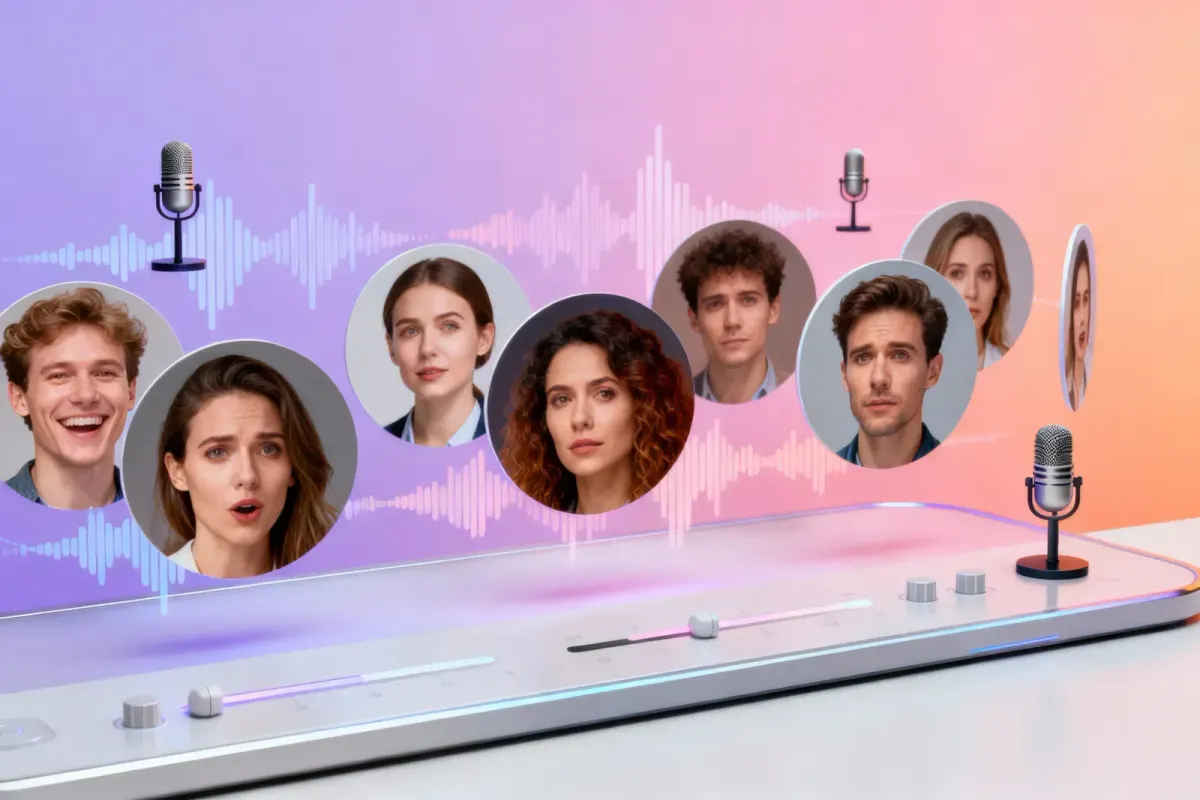 ToolPublic Domain Audiobook MakerTurn a classic from Project Gutenberg or Standard Ebooks into a full-cast audiobook, after checking its status where you publish.GenreNonfiction NarrationOne clear narrator for self-help, business and memoir, chapters from your headings, and a second voice only where it helps.
 GenreChildren's Audiobook NarrationA warm narrator, character voices kids can tell apart and a bedtime pace, for picture books, chapter books and your own stories.
 GuideAudiobook rights, in plain languageWho holds audio rights, what public domain covers, fan works, YouTube, and a permission request you can copy.ComparisonFull cast vs single narratorWhen a cast helps a book, when one narrator is the better choice, and what each costs with human performers or AI voices.
Choose a public-domain translation, cast the narrator and the speakers, and build dramatized Bible audio one book at a time. Free to start.